
Traditional Window Cleaning
Traditional window cleaning involves using cleaning solutions, a squeegee, and cloths or scrapers to remove dirt, grime, and streaks from windows. This method typically requires a ladder or scaffolding to access higher windows, allowing the cleaner to physically reach the glass.
Process:
- A cleaning solution (often a mix of water and detergent) is applied to the window surface.
- The surface is scrubbed to loosen dirt and debris.
- A squeegee is used to wipe the window clean, removing excess water and leaving a streak-free finish.
- Any remaining water or cleaning solution is wiped away with a cloth or sponge.
Advantages:
- Ideal for smaller, accessible windows.
- Allows for detailed attention, particularly on glass with built-up grime.
- Often quicker for smaller-scale cleaning tasks.
Disadvantages:
- For high-rise or hard-to-reach windows, ladders or lifts may be necessary, posing safety risks.
- Can leave streaks if not done correctly or if improper cleaning solutions are used.
- Involves the use of chemicals and detergents, which may not be environmentally friendly.
Water Fed Window Cleaning
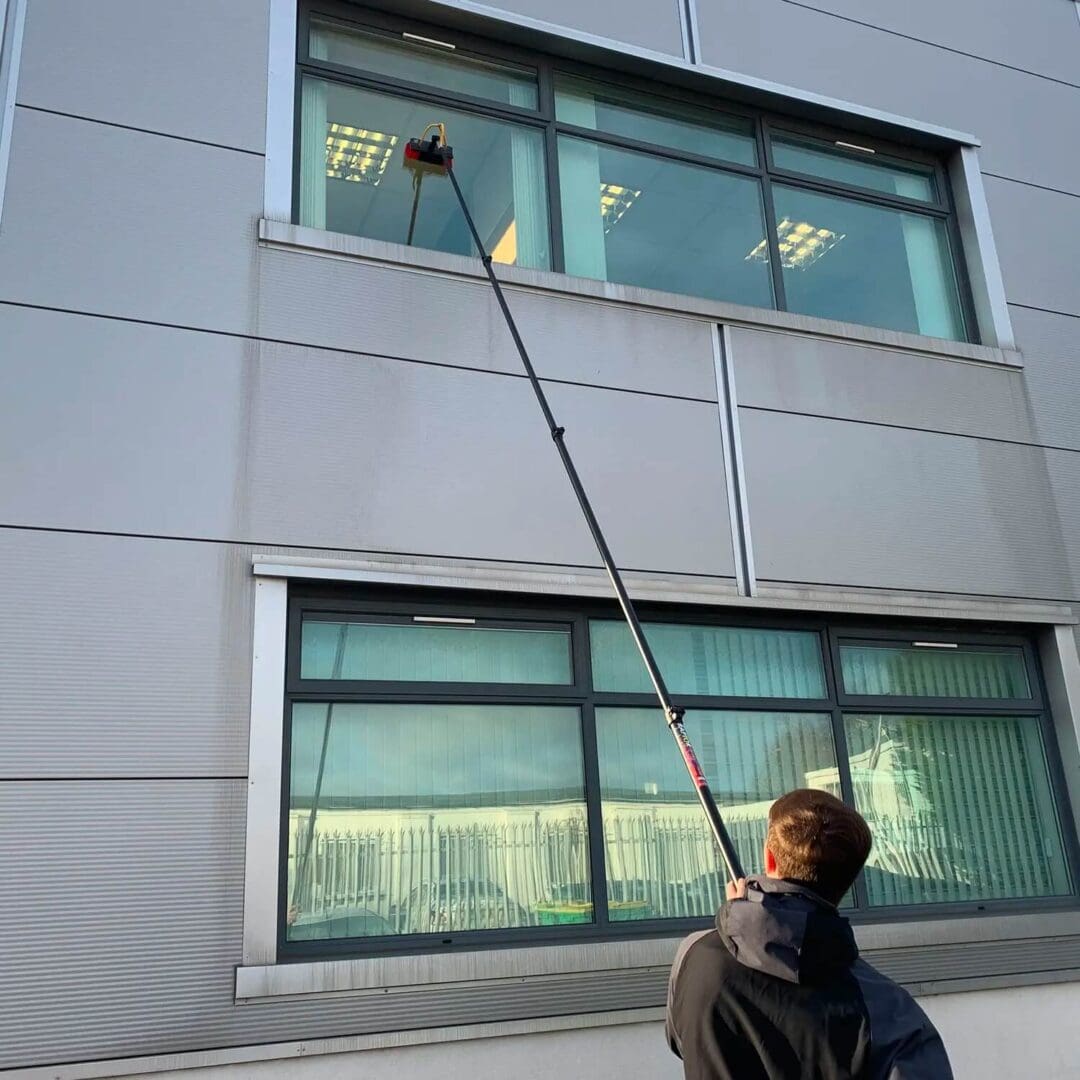
Water fed window cleaning uses purified, demineralized water combined with a telescopic pole and brush system to clean windows without the need for ladders or chemicals. The purified water is sprayed directly onto the window, where it is scrubbed with a soft brush and then rinsed off.
Process:
- Purified water (often deionized to remove minerals) is pumped through a telescopic pole.
- The water is directed to the window surface and scrubbed with a soft, brush head that loosens dirt and debris.
- The water is then rinsed away, leaving the windows clean and streak-free.
Advantages:
- No need for ladders, scaffolding, or harsh chemicals, making it a safer and more eco-friendly option.
- Purified water dries without leaving any streaks or residue, ensuring a spotless finish.
- Can easily reach higher or more difficult-to-access windows, such as those on multi-story buildings.
- Ideal for both residential and commercial properties, especially those with larger window surfaces.
Disadvantages:
- Requires specialized equipment, which may make it more expensive than traditional methods.
- While effective, it may not be as ideal for extremely dirty windows with built-up grime that needs scrubbing.